
The waste module of your e-MJV, completed and substantiated
The e-MJV, the annual environmental report that industrial sites in the Netherlands must file, costs HSE teams at least 70 hours per site every year, often topped up with a hired consultant who checks everything. geoFluxus brings together the waste data of all your Dutch sites and waste collectors, classifies and checks it, and delivers the waste report in exactly the format of the e-MJV. Every figure is traceable to its source.













Fewer hours, no external check needed
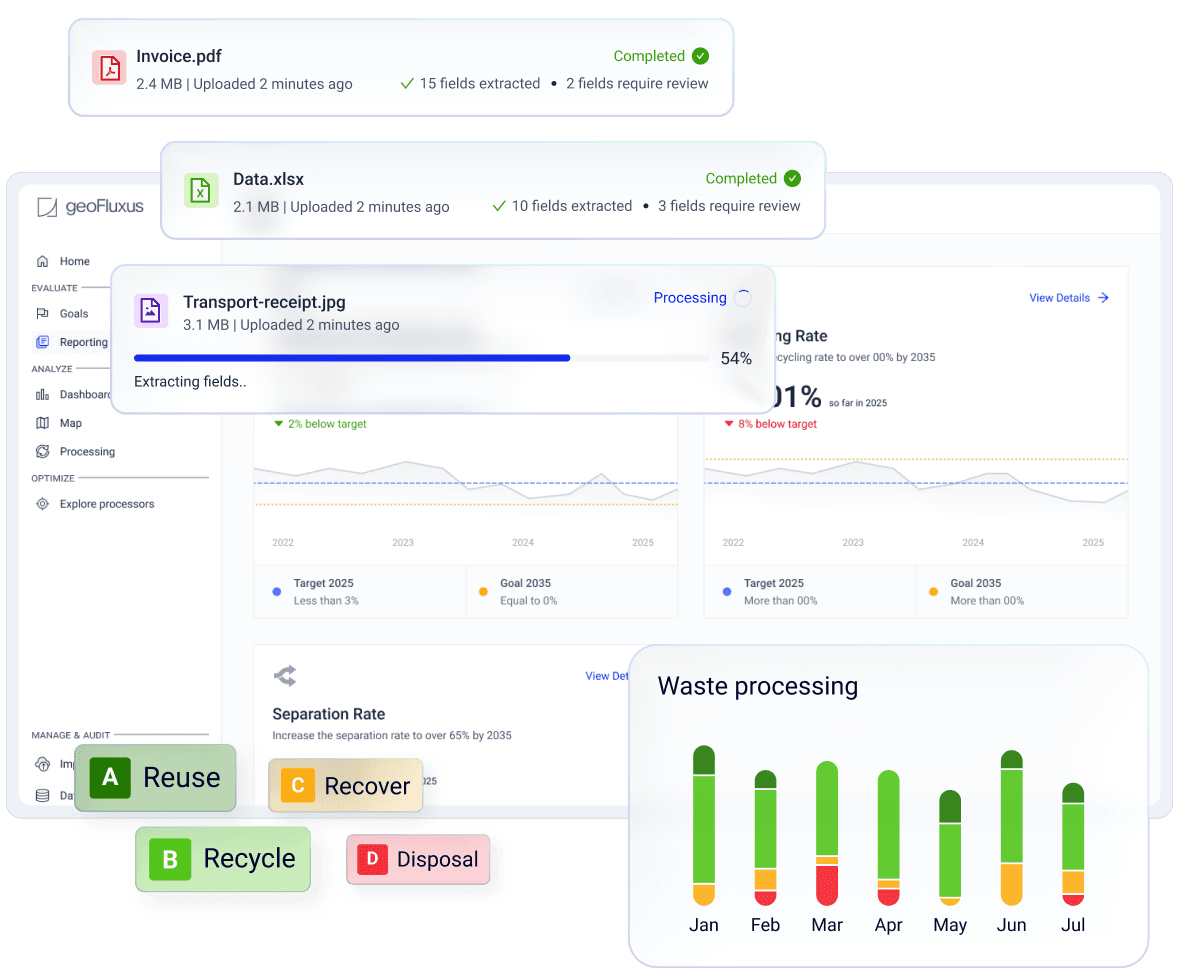
Your team spends far less time on the e-MJV. And because we already check the data, an additional review by an external consultant is no longer needed.
Know right away whether you have to report
You only know whether you are above the waste threshold once all the figures are lined up. We take that work off your hands. You know right away whether you have to report, and if you do, the report is already waiting.
Insight into all your waste streams
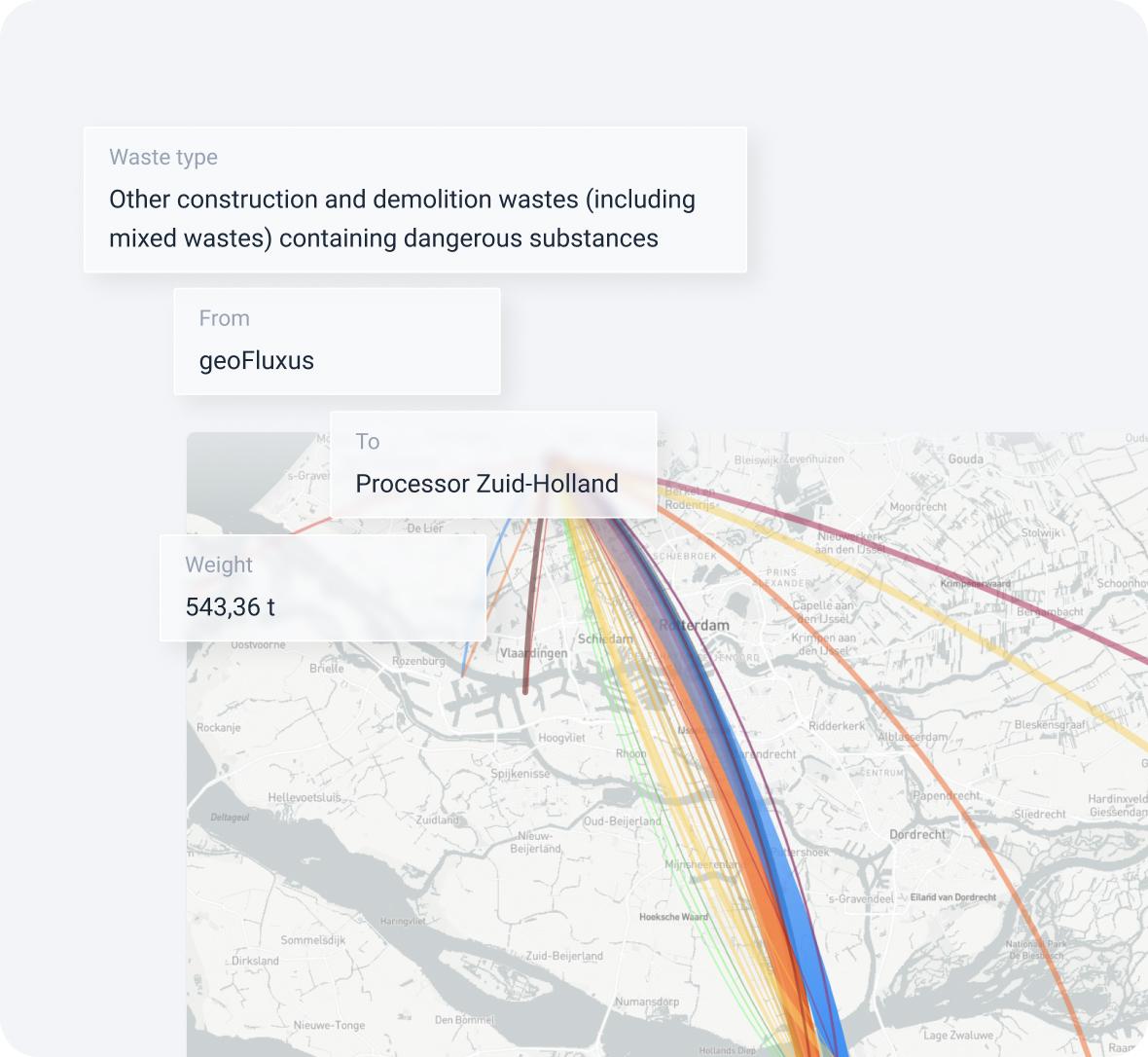
For each site you see which waste streams you have and where they go. That way you get more out of an obligation: where can you save, and what could be separated better?
Ready for the new rules
New European rules apply from reporting year 2027: more companies fall under the reporting obligation, and you report per installation instead of per site. With geoFluxus you are already prepared.
The e-MJV in brief
What is the e-MJV?
The e-MJV is the Dutch electronic annual environmental report (elektronisch milieujaarverslag). Industrial companies use it to report every year on their emissions to air, water and soil, their waste and, where required, their energy and water use. The report is officially called the Integrated PRTR report (Integraal PRTR-verslag). The e-MJV is how sites in the Netherlands file under the European PRTR Regulation. It applies only to sites located in the Netherlands.
Where does the e-MJV come from?
With the e-MJV, the Netherlands meets international agreements on industrial emissions. It is based on the European PRTR Regulation, which in turn stems from the 2003 Kyiv Protocol. That treaty obliges countries to record and publish what industrial companies emit and transfer as waste. That is why the data from the e-MJV is published too: anyone can look it up per site.
Who does it apply to?
Sites in the Netherlands that carry out an activity listed in Annex I of the PRTR Regulation above the capacity threshold. Think of chemicals, metals, food and drink, paper, energy and waste treatment. The site must also exceed a reporting threshold. For waste that is more than 2 tonnes of hazardous waste or more than 2,000 tonnes of non-hazardous waste per year.
Notably, you only know whether you exceed the waste threshold once everything that left the site during the year has been added up. In effect you have to do the work to find out whether you need to report. That is why the obligation to keep records also applies if you end up below the threshold. Without records you cannot show that reporting was not required.
When?
The e-MJV opens in early January. The report on the previous calendar year must be published by 31 March at the latest. After that, the assessing body reviews the report, in principle before 1 July. In the e-MJV this is the body that carries out the assessment. Increasingly this is not the statutory competent authority itself, but an executive agency acting on its behalf.
Read more in What is the e-MJV and how do you handle it?
How the e-MJV process works
- Collect the data. Throughout the year you record your emissions and your waste transfers. In early January you bring everything together: statements from waste collectors, invoices and weighbridge tickets.
- Classify and check. Each waste stream is given the correct EURAL code (the Dutch version of the European List of Waste), treatment method and determination method. You compare your figures with last year's and with the LMA data, the Dutch national waste register, and explain the differences.
- Enter and submit. You enter the data in the e-MJV and publish the report, by 31 March at the latest.
- Assessment and questions. The competent authority assesses your report, in principle before 1 July. There are always questions, especially about the waste section. That is because your figures almost never match the LMA data exactly. As the reporting company, you have to explain those differences.
- Publication. After approval, the data is made public through the national PRTR.
What the waste module asks of you
For waste, an annual total is not enough. You report per waste stream:
- The EURAL code, which distinguishes hazardous from non-hazardous waste.
- The quantity in tonnes per year.
- The treatment method: reuse or recovery, use as fuel, incineration, landfill, or a waste sorting facility.
- The R or D code: recovery (R1 to R13) or disposal (D1 to D15).
- The determination method: measured, calculated or estimated, and how.
- For exports of hazardous waste: the name and address of the foreign processor and the location where the waste is actually treated.
If you exceed either of the two thresholds, you report both your hazardous and your non-hazardous waste. Everything that leaves the site counts, including waste from third parties and waste removed by subcontractors.
In addition, your way of working must be laid down in a measurement and registration system: which data you collect, how you determine it and how often. You keep the supporting evidence for five years.
A common mistake: recovery is not the same as recycling. Incineration as fuel (R1) also counts as recovery. If you use the same figures for your circularity targets, that distinction matters.
For a step-by-step guide to the waste module, read EURAL codes, R and D codes and M/C/E: how to complete the waste module.
Where it goes wrong in practice
The waste collector's statement is not automatically enough. Your collector's annual statement is a good source, but responsibility for the report stays with you. You have to be able to show that all streams are included and that classification and treatment are correct.
Multiple sites, multiple collectors, multiple formats. Every waste collector supplies its data differently. Organisations with several sites therefore merge spreadsheets, invoices and weighbridge tickets by hand every year. A group account (concernaccount) lets you log in centrally for all your sites, but you still have to collect the data per site yourself.
Read more in The e-MJV with multiple sites.
You have to be able to explain differences. The competent authority compares your figures with last year's and with the data of the LMA (Landelijk Meldpunt Afvalstoffen), the Dutch national waste register. In practice we see differences of 10 to 60% between the LMA data and actual waste streams. As a result, there are always questions about your report. geoFluxus also has access to the LMA data under a data use agreement and explains the differences in advance. You get fewer questions, and you can answer the ones that do come straight away, because your records are in order.
Read more in Why your LMA data does not match your own waste data.
Everything is manual. The waste module has no import function. Every waste stream is entered line by line.
The knowledge sits with one person. Often only one colleague knows how it went last year. If that person is unavailable, the team starts from scratch.
How it works with geoFluxus
- Supply your documents. You upload or email invoices, weighbridge tickets and waste transport notes, or we connect directly to your ERP system or your waste collectors. All sites and all collectors in one place.
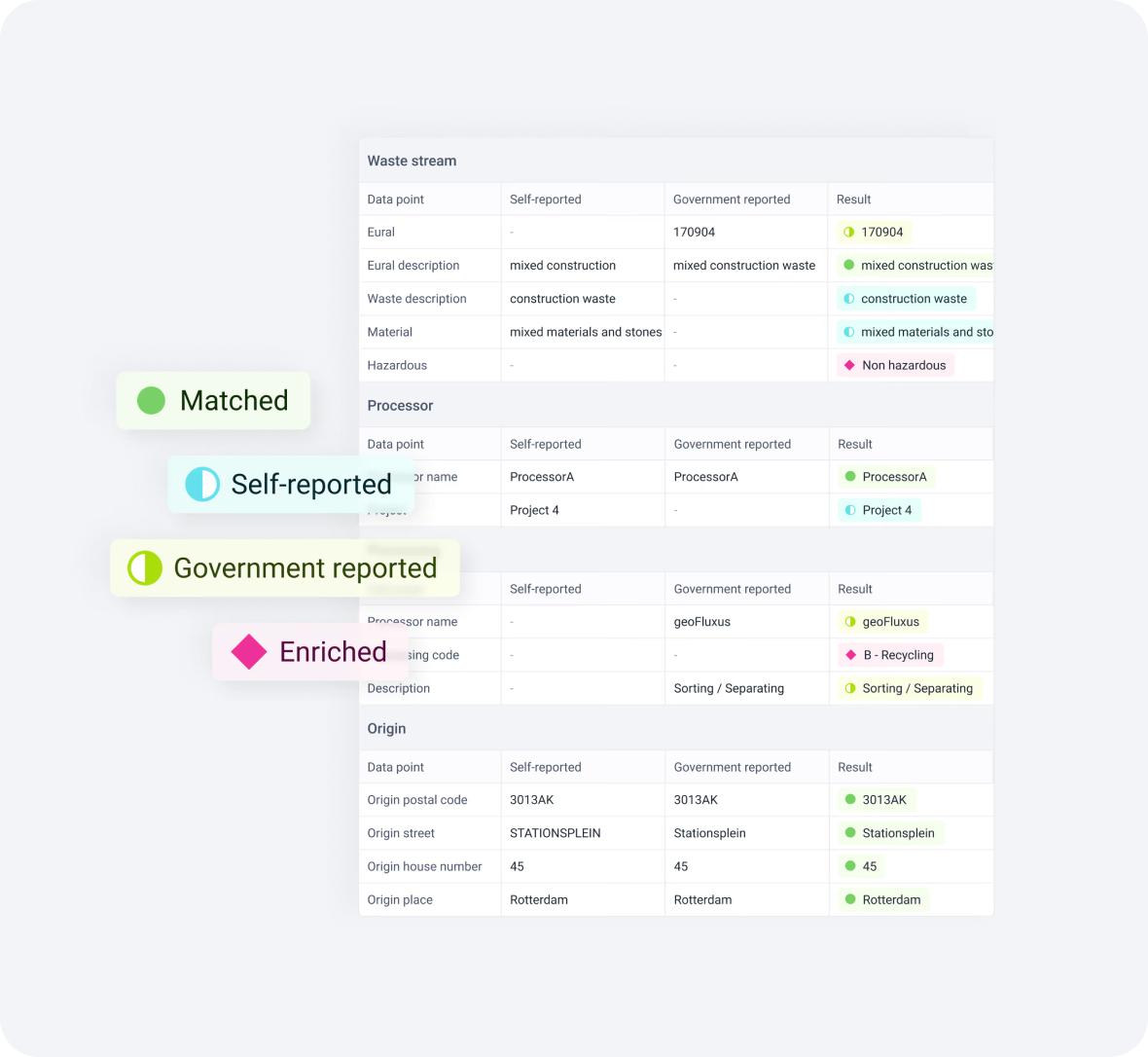
- Classify and enrich. Our algorithms link each stream to the correct EURAL code, treatment method and R or D code, and fill in missing data. Waste experts validate every data point.
- Check. We compare your source data with the LMA data and with last year's figures, and trace duplicates and missing data. The LMA data is not always correct, and as the reporting company you have to explain the differences. We show them in advance, so you can explain them before the competent authority asks.
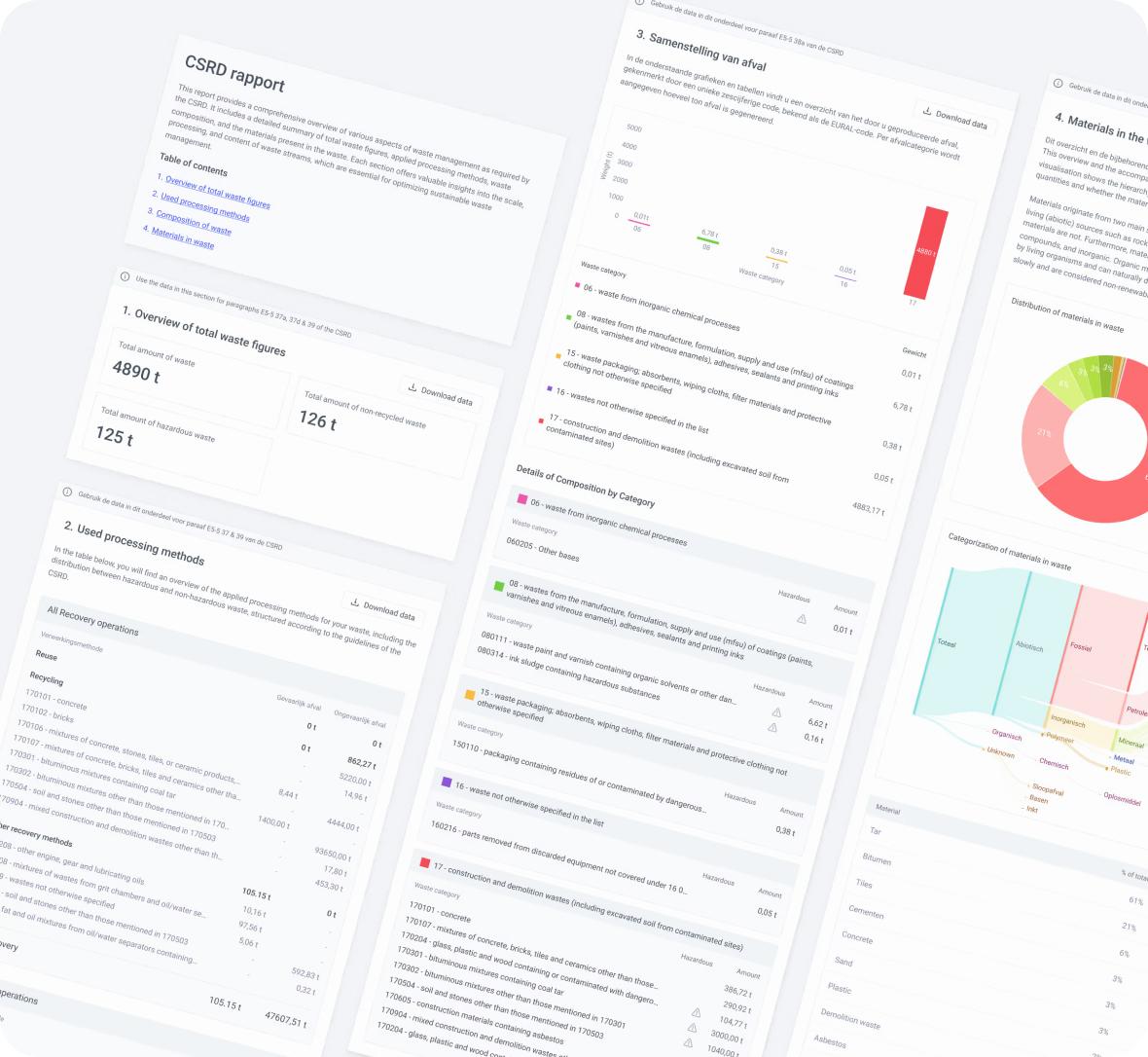
- Delivery of the report. For each site you receive the waste report in exactly the format of the waste module, including the supporting evidence. You can attach it to your e-MJV.
- Submit. Your team copies the figures into the e-MJV and publishes the report. Because the figures are correct and the evidence is ready, all that is left is copying the figures, not working them out.
Worked example
A manufacturing company with three sites in the Netherlands and five waste collectors.
Doing the waste section yourself takes at least 70 hours per site per year. For three sites that is more than 200 hours. Most of the work on waste is in collecting, classifying and checking: exactly the part geoFluxus takes over. Add an external adviser who checks everything, and the costs come back every year.
With geoFluxus, all that remains for the HSE team is copying the figures and publishing. The rest is ready.
What it costs, and what you gain
The e-MJV is an obligation without a return. You report, and you get nothing back. The costs are real, but they are invisible:
- Internal hours of your HSE team, year after year, for every site.
- An external adviser who checks the report, because nobody wants to take a risk.
- The risk of questions, corrections or enforcement if the figures are not right.
geoFluxus sets one fixed price against that, and it is lower than what the work costs you now. You can also use the same data for other reports, such as ISO 14001, CSRD (ESRS E5) and Scope 3.
Does this need to go through procurement? We put the business case for your organisation on a single page: your current hours and costs, compared with geoFluxus.
Ready for 2027
From reporting year 2027, to be reported for the first time in 2028, the European Industrial Emissions Portal Regulation (IEP, in Dutch PIE-verordening) replaces the current E-PRTR. More changes than the name. Annex I of that regulation adds activities, including medium-sized combustion plants, mining and oil and gas extraction, opencast mining, urban waste water treatment plants, shipyards and hydrogen production by electrolysis. Article 6 now requires reporting per installation instead of per site, and in addition to emissions and waste also on your water and energy consumption and on relevant raw materials. If you stay below a threshold value, you will have to declare that in your report. The two thresholds for waste stay the same: more than 2 tonnes of hazardous waste or more than 2,000 tonnes of non-hazardous waste per year per site. What this means for the Netherlands is set out in the explanatory memorandum (in Dutch) to the bill that implements the regulation.
If you set up your waste records now in a spreadsheet for the current format, you will have to do it again later. With geoFluxus your waste data is structured per stream, per site and per processor, whatever changes.
Frequently asked questions
That depends on three things: your site in the Netherlands carries out an activity listed in Annex I of the PRTR Regulation, you are above the capacity threshold, and you exceed a reporting threshold for emissions or waste. For waste that is more than 2 tonnes of hazardous waste or more than 2,000 tonnes of non-hazardous waste per year. If your activity falls under the scheme, you also have to keep records when you stay below the thresholds.
The e-MJV opens in early January. The report on the previous calendar year must be published by 31 March at the latest.
Not automatically. It is an important source, but you have to judge for yourself whether all streams are included and whether classification, quantities and treatment are correct. Responsibility for the report stays with you.
No. The waste module has no import function; you enter each stream by hand. You can attach an Excel file with the supporting evidence.
In the e-MJV, the company that produces the waste reports it; to the LMA, the Dutch national waste register, the party that receives it does. The competent authority does compare the two, so they have to match.
Almost always. The competent authority compares your waste figures with the LMA data, and in practice that data differs 10 to 60% from actual waste streams. As the reporting company you have to explain those differences. If you do that in advance and can substantiate every figure, you answer the questions quickly.
From reporting year 2027 the European Industrial Emissions Portal Regulation (IEP) applies instead of the current E-PRTR. More companies fall under the reporting obligation, you report per installation instead of per site, and in addition to emissions and waste you also report on water and energy consumption and relevant raw materials. The thresholds for waste stay the same: more than 2 tonnes of hazardous waste or more than 2,000 tonnes of non-hazardous waste per year per site. The first report under the new rules is due in 2028.
You supply the source documents, or we connect to your systems. We classify, check and deliver the waste report per site, with supporting evidence. Your team copies the figures into the e-MJV and publishes the report.
Yes. You use the same structured waste data for ISO 14001, ESRS E5, Scope 3 category 5 and your own circularity targets.
The competent authority can impose an order subject to a penalty payment, and a report that does not meet the requirements can receive a negative declaration. That is recorded in the public national PRTR. Breaching the reporting rules is also an economic offence under Dutch law, punishable by fines. Fraud is in principle prosecuted under criminal law.
To see how the assessment works and how to deal with questions, read What happens after you submit your e-MJV?
Receive your business case
Let us know how many sites you have, and we will set out briefly what the e-MJV costs you now and what it costs with geoFluxus.