
TL;DR
- After publication, the competent authority assesses your report for completeness, consistency and accuracy, in principle before 1 July.
- Questions are usually about differences from last year, differences from the LMA data, missing streams, the treatment method and the determination method.
- If you can show the source of every figure and have explained differences in advance, you get through the round of questions quickly.
Publishing the e-MJV, the annual environmental report for industrial sites in the Netherlands, before 31 March does not finish the job. The competent authority then assesses your report, and in practice questions always follow. In this blog you can read how that assessment works and how to make sure it is completed quickly.
How the assessment works
After publication, your report goes to the competent authority linked to your site, usually the province or the regional environmental service (omgevingsdienst) that works on behalf of the province. The competent authority assesses the report on three points:
- Completeness: does it contain everything it should?
- Consistency: do the figures match each other, and last year's?
- Accuracy: are the figures plausible and well substantiated?
The competent authority also looks at your measurement and registration system: how do you arrive at your figures? If in doubt, it can ask for clarification or for a change. That often goes through the e-MJV itself.
The deadlines
- Before 1 April: your report has been submitted.
- Before 1 July: the competent authority has assessed your report, including any additions.
- 30 September at the latest: the assessment can be extended until this date.
- 1 October: the e-MJV closes. Everything concerning the reporting year must be completed by then.
So the questions come in between April and July. Make sure someone keeps track of them, including during the holiday period.
What the questions are about
For the waste section, the questions are usually about a number of fixed topics:
- Differences from last year. Differences of more than 10% per EURAL code (the Dutch version of the European List of Waste) often lead to a request for an explanation.
- Differences from the LMA. The competent authority compares your figures with the data of the LMA (Landelijk Meldpunt Afvalstoffen), the Dutch national waste register. In practice that data differs 10 to 60% from actual waste streams. Read more in Why your LMA data does not match your own waste data.
- Missing streams. A stream that was in your report last year and is not now, or a waste collector that does not appear again.
- The treatment method. For example if you entered R13 or D15, which is storage only.
- The determination method. Many estimated quantities lead to questions.
- Empty fields, such as on-site treatment that has not been completed and has not been ticked as "not applicable" either.
How to answer the questions quickly
Make sure every figure has a source. If you can show which invoice, weighbridge ticket or waste transport note a figure comes from, a question is answered quickly. If you still have to trace it in separate spreadsheets, it takes you weeks.
Record explanations in advance. Did you already investigate and describe the large differences before submitting? Then attach that explanation. Often the question is then not asked at all.
Do not leave the knowledge with one person. If only the colleague who prepared the report knows the answers, you have a problem when that person is away. Document your way of working.
Respond in good time. The competent authority has to be finished before 1 July. The faster you respond, the smaller the chance of another round of questions.
How geoFluxus helps you answer questions quickly
These points take a lot of preparation, especially with several sites and collectors. geoFluxus takes over that work:
- All source documents in one place. Invoices, weighbridge tickets and waste transport notes from all your sites and collectors are collected centrally, by upload or through a connection with your ERP or your collectors.
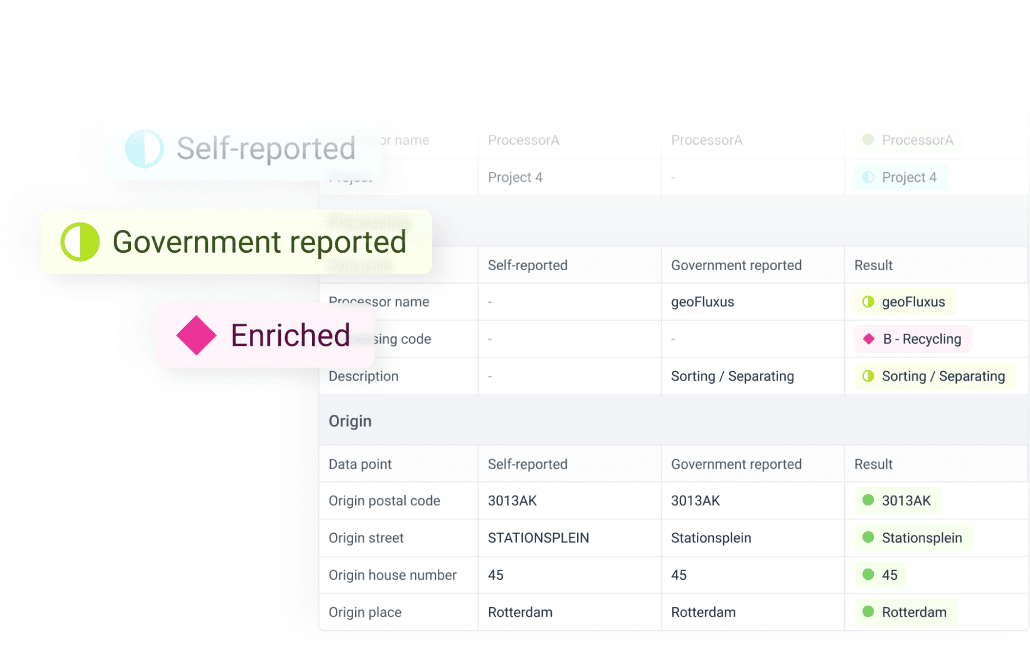
- Every figure traceable to the source. Every quantity in the report is linked to the document it comes from.
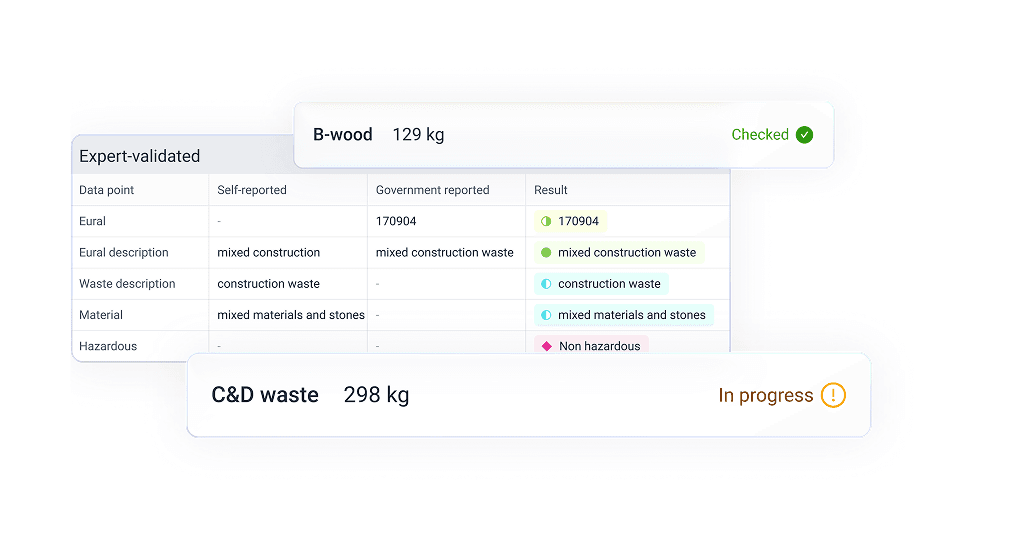
- Correct classification. Each stream is given the correct EURAL code, treatment method and R or D code. Waste experts validate every data point.
- Compared with the LMA in advance. geoFluxus has access to the LMA data and compares it with your source data per EURAL code and per site.
- Compared with last year. Differences from the previous reporting year are made visible, and duplicates and missing streams are traced.
- Differences explained in advance. You receive the explanation of the differences before you submit, so you can send it along as an attachment.
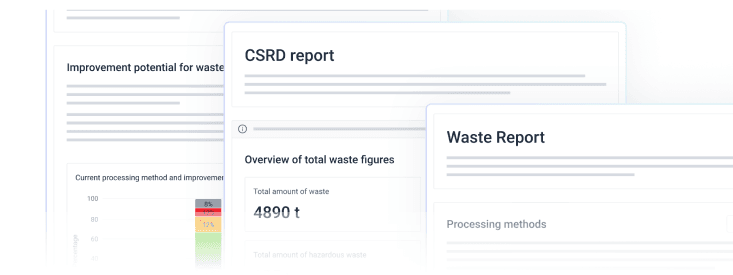
- Report in the format of the waste module. Per site, with the full supporting evidence.
If a question comes from the competent authority, the answer is therefore already there. You no longer have to look anything up in separate files. Read how geoFluxus delivers the waste report.
The outcomes
At the end of the assessment there are three possibilities:
- Accepted: you are done for this year.
- Additional information requested: you adjust the data and publish again.
- Not accepted: the report does not meet the requirements and was not corrected in time.
If it does not go well
If the quality remains insufficient, the competent authority can impose an order subject to a penalty payment (last onder dwangsom). If you still do not put the report right, the penalty becomes due. If the report still does not meet the requirements after that, the competent authority can issue a negative declaration. This is recorded in the national PRTR, and that register is public.
Deliberately incorrect reporting is also an economic offence under Dutch law. In principle it is prosecuted under criminal law.
Changing something afterwards
Do you discover an error after acceptance? Then you use the e-MJV amendment form (mutatieformulier). Do that as soon as possible, and in any case before the data is made public.
In conclusion
Submitting is only half the work. If your supporting evidence is in order, you are finished quickly after the round of questions. Read how geoFluxus delivers the waste report.
Related Content