


“Over the years we’ve invested significantly in our field data team - focusing on producing trusted ratings. While this ensures the accuracy of our Ratings, it doesn’t allow the scale across the thousands of projects that buyers are considering.”

For more information on carbon credit procurement trends, read our "Key Takeaways for 2025" article. We share five, data-backed tips to improve your procurement strategy.
One more thing: Connect to Supply customers also get access to the rest of Sylvera's tools. That means you can easily see project ratings and evaluate an individual project's strengths, procure quality carbon credits, and even monitor project activity (particularly if you’ve invested at the pre-issuance stage.)
Book a free demo of Sylvera to see our platform's procurement and reporting features in action.
Why Corporate ESG Reporting Breaks Down In Large Organisations
Corporate ESG reporting becomes difficult as soon as organisations move beyond a single site, a single business unit or a single data owner. Large enterprises typically operate across multiple countries, work with dozens of contractors and rely on fragmented systems to manage environmental, social and governance data.
In practice, ESG data lives across sustainability teams, QHSE functions, procurement, finance and operations. Each team collects information for its own purpose, often using different definitions, timeframes and tools. When reporting time arrives, these datasets are stitched together manually into an annual ESG report or corporate ESG report.
This fragmentation explains why many ESG reporting efforts struggle. The problem is rarely a lack of ambition or awareness. It is the absence of a single, reliable source of operational data that can support consistent ESG disclosures year after year.
What Most ESG Reports Still Focus On — and What They Miss
ESG reports play a crucial role in showcasing a company's performance and overall impact, providing stakeholders with transparent information about progress and commitment to responsible practices.

The current focus on greenhouse gases within ESG reports creates blind spots. Waste generation, material use, circularity outcomes and treatment methods are often summarised at a high level or excluded entirely. In an ESG report of a company, waste might appear as a single number without explanation of where it came from, how it was treated or whether the data is comparable across years. To improve transparency and build trust, companies should communicate and reflect on their ESG efforts and ESG initiatives, ensuring these are measured and reported alongside other key metrics.
This imbalance shows up clearly during ESG report analysis. Carbon figures tend to be robust and auditable, while waste and material data is often inconsistent, incomplete or based on assumptions rather than evidence. It is essential that sustainability efforts are aligned with ESG disclosures to ensure credibility and avoid accusations of greenwashing. Transparent and standardized ESG reporting can also discourage and combat greenwashing, supporting more reliable and effective disclosures.
Waste and Material Flows: The Weakest Link in ESG Reporting Frameworks
In practice, this weakness shows up in how waste data is collected, classified and verified across sites. What looks consistent at report level often breaks down at stream level, where differences in classification, coding, and documentation make data difficult to compare or audit.

Unlike carbon emissions, which are typically calculated using standardised methodologies and centralised data models, waste and material flows depend on operational records generated by dozens of contractors, facilities and local regulations. That fragmentation makes errors harder to detect and inconsistencies easier to normalise.
Under CSRD – ESRS E5, these gaps matter. Waste and material disclosures are rapidly becoming as auditable as financial data. Without traceable source data and consistent classification across suppliers and sites, companies struggle to defend their figures even when overall ESG reporting processes appear mature.
What waste data typically looks like today
In most large enterprises, the challenge is not basic hazardous versus non-hazardous classification — that distinction is usually well controlled due to regulatory risk. The problem is that waste data is scattered across invoices, transport documents, contractor portals and site-level systems, making it difficult to assemble a single, consistent view of what actually happened across the organisation.
Treatment outcomes are legally determined by the licensed facility that receives the waste and recorded by the processor in government registers, not certified by the waste-producing company itself. However, linking internal waste records to those downstream treatment registrations is rarely straightforward at scale. Without that linkage, teams struggle to demonstrate how reported figures connect to actual treatment routes.
Producing a robust ESG analysis report on waste therefore requires more than collecting numbers. It requires technical understanding of waste categories, treatment licences and regulatory reporting, combined with structured data that can be interpreted consistently across sites and years. Without both, waste disclosures remain difficult to verify and even harder to defend under assurance.
Difficulties of waste data
- Scattered data -> can’t trace to source
- Gaps in data (invoices don’t always include treatment route) -> circularity claims
- Difficult to standardize -> can lead to inconsistencies
- Expertise required to understand

In addition to environmental data, governance metrics, such as board diversity, executive compensation, and business ethics, are also key components of ESG reporting and should be included to provide a comprehensive view of corporate governance.
Why this undermines ESG disclosures
These gaps directly weaken ESG disclosures. If waste quantities cannot be traced back to source documents, they cannot be verified. If treatment methods are unclear, circularity claims become difficult to defend. If data changes significantly from year to year, stakeholders question its credibility.
As ESG reporting deadlines approach, these issues surface quickly. Sustainability teams spend weeks chasing data rather than analysing performance. Teams struggle to validate numbers. Auditors request evidence that is difficult to retrieve.
Given the rapidly changing regulatory landscape for ESG reporting, it is crucial for organizations to adhere to recognized standards and stay compliant with evolving ESG regulations to ensure transparency, credibility, and regulatory compliance in their sustainability disclosures.
Circularity Reporting Fails When Material Flows Aren’t Visible
Circularity is now a core part of corporate sustainability strategies, yet it remains one of the least measurable elements in ESG reporting. Many companies describe circular initiatives narratively but lack the data to quantify results. To achieve measurable outcomes, organizations must implement robust sustainability initiatives and develop a clear sustainability strategy that outlines environmental and social goals, initiatives, and performance metrics.
Without visibility into material flows, it is impossible to determine how much waste stays in high-value loops, how much is downgraded or how contamination affects recycling outcomes. Circularity becomes difficult to measure consistently.
Effective sustainability reporting requires linking waste streams to actual treatment routes and outcomes. This is where data on materials, processors and destinations becomes essential. Without it, circularity targets remain aspirational rather than operational. Both public and private companies can utilize frameworks such as the Global Reporting Initiative (GRI), Corporate Sustainability Reporting Directive (CSRD), Sustainability Accounting Standards Board (SASB), and Task Force on Climate-related Financial Disclosures (TCFD) to structure their ESG disclosures.
Data Quality is the Real ESG Reporting Challenge
Most ESG reporting challenges are data challenges. Reporting frameworks, sustainability standards and regulatory guidance are well documented. What organisations struggle with is turning operational activity into consistent, reliable ESG data.
Common issues include missing documentation, inconsistent classifications, duplicate records and manual reconciliation. These problems affect ESG metrics across environmental, social and governance topics, but they are especially acute in waste and material reporting.

Accurate ESG disclosures depend on traceability. Every reported figure should link back to a source document, whether that is a waste ticket, or invoice. Without this foundation, ESG compliance becomes increasingly difficult as scrutiny increases.
This is why many organisations are investing in data automation and verification rather than new reporting templates. Improving inputs has a far greater impact on reporting quality than reformatting outputs.
What Changes in ESG Reporting for 2026
ESG reporting in 2026 reflects a clear shift toward more structured, evidence-based disclosure. Regulatory developments such as CSRD, combined with investor and auditor expectations, are increasing the emphasis on data quality, consistency, and assurance across ESG topics.
Reporting requirements are becoming more detailed, and organisations are seeing closer alignment between sustainability, finance, and risk functions as ESG data is subject to greater internal control and external review. Companies are increasingly expected to support reported metrics with traceable source data, rather than relying primarily on narrative descriptions of policies or intentions.
For many CSRD-in-scope organisations, the 2026 reporting cycle will be the first to involve deeper scrutiny of waste, materials, and circularity data. As data volumes and validation requirements grow, internal reporting timelines feel more compressed, particularly for teams that rely on manual data collection and reconciliation processes.
What a Credible Corporate ESG Report Includes Beyond Carbon
A credible corporate ESG report goes beyond carbon emissions to reflect how a company actually operates. A credible corporate ESG report typically includes:
- Clearly defined reporting boundaries and scopes
- Consistent metrics across sites and years, with traceable source evidence
- Energy use and energy mix (including renewable share and intensity)
- Water withdrawals/consumption and discharge, including location context where relevant
- Waste generation by category and material, plus treatment outcomes (recycling, recovery, disposal)
- Materials and resource use (key inputs, recycled content, circularity metrics where material)
- Core social metrics (health & safety, workforce composition, turnover, training)
- Governance disclosures (board oversight, executive pay, internal controls, ethics/compliance)
ESG reporting involves the transparent disclosure of a company's performance and initiatives related to environmental, social, and governance factors, providing stakeholders with a comprehensive view of the company's overall impact and commitment to responsible and sustainable practices.
This approach supports stronger ESG corporate reporting by grounding sustainability narratives in operational reality. It also helps organisations respond more effectively to stakeholder expectations around transparency and accountability.
Why ESG Performance Reporting Fails Without Cross-Team Ownership
ESG reporting cannot be owned by one team alone. Sustainability teams often define strategy and narrative, but they depend on QHSE teams for classification, procurement teams for vendor data and finance teams for controls and assurance.
When these functions operate in silos, inconsistencies appear quickly. Data definitions diverge, timelines slip and reporting becomes reactive. Successful corporate ESG performance relies on shared ownership of a single dataset that serves multiple use cases.
This is especially true for waste and materials data, which sits at the intersection of compliance, cost management and sustainability performance.
How geoFluxus Supports ESG Reporting Beyond Carbon
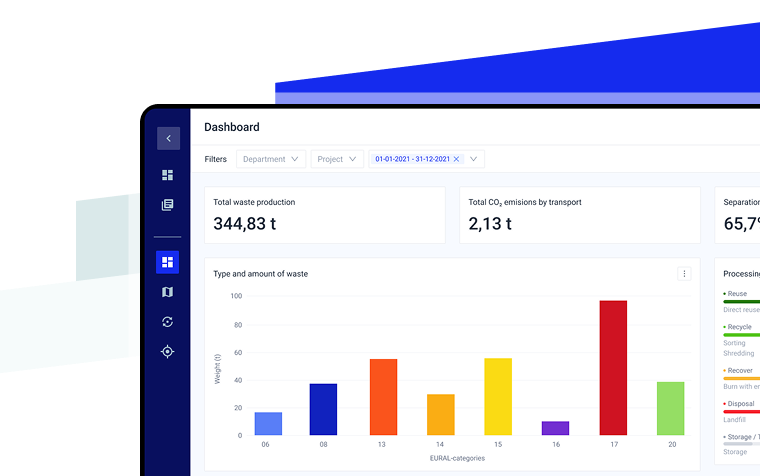
geoFluxus supports corporate ESG reporting by acting as a data and analytics layer for waste, materials and circularity. It ingests data from multiple contractors and sites, standardises classifications and links every figure to supporting evidence.
This enables organisations to produce ESG disclosures that are consistent, traceable and audit-ready. Teams can benchmark performance, analyse trends and export data for compliance reporting without rebuilding spreadsheets each year.
By improving data quality at the source, geoFluxus helps enterprises move from reactive ESG reporting to continuous performance management. Want to see first-hand? Book a demo to see how this works in practice.
Conclusion
Corporate ESG reporting is no longer just about publishing a polished annual report. It is about demonstrating control over operational data and translating that data into credible disclosures. Integrating ESG principles is essential for guiding sustainable business practices, enhancing transparency, and building trust with stakeholders.
Carbon remains important, but it is not enough. Waste, materials and circularity are where ESG reporting credibility is tested. Enterprises that invest in standardised, verifiable data are better positioned to meet ESG reporting requirements in 2026 and beyond.
Better data leads to better reporting, stronger compliance and a more sustainable future. Robust ESG reporting not only demonstrates a commitment to ESG principles and long-term value creation, but also enhances a company's reputation in capital markets, where investor scrutiny and stakeholder demand are driving the trend toward mandatory ESG disclosures.
FAQs
What should corporate ESG reporting include beyond carbon?
Beyond carbon emissions, corporate ESG reporting should include waste generation, treatment outcomes, material flows, circularity performance and supporting evidence for disclosures.
Why does waste data cause so many ESG reporting issues?
Waste data is often fragmented across sites and contractors, making it difficult to standardise, verify and trace. This creates inconsistencies in ESG reports.
How do ESG reporting deadlines affect operational teams?
As ESG reporting deadlines tighten, operational teams face increased pressure to deliver accurate data quickly. Manual processes often become bottlenecks.
Who should own waste and circularity data in ESG reporting?
Waste and circularity data should be jointly owned by sustainability, QHSE, procurement and finance teams, using a shared data foundation.
What makes an ESG report audit-ready?
An ESG report is audit-ready when every reported figure can be traced back to source documents, classifications are consistent and assumptions are clearly documented.